|

In
this new periodic feature, Bob Brooke offers personal insights into the
world of antiques and antiques collecting.
LATEST EXTRA!_______________________________________
In Antiques, What Does
It Mean to be American?
by Bob Brooke
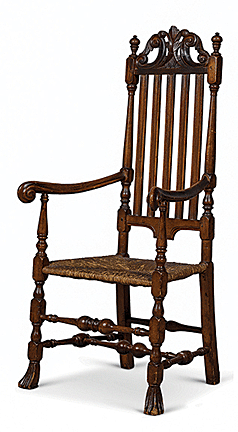 The
word antiques is a broad term. In fact, it applies to objects that are
at least 100 years old, including those made anywhere in the world. But
what exactly is an American antique? And while this may seem obvious—any
object made in the United States----trying to pin that down can be
complicated. The
word antiques is a broad term. In fact, it applies to objects that are
at least 100 years old, including those made anywhere in the world. But
what exactly is an American antique? And while this may seem obvious—any
object made in the United States----trying to pin that down can be
complicated.
When colonists first came to the New World, they brought with them
essential pieces of furniture, tools, and other items to use in setting
up their new settlements. Later on, after towns had become established
and trade with the Old World had been launched, people began importing
finer household goods.
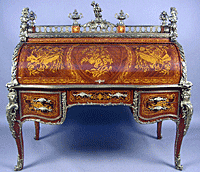
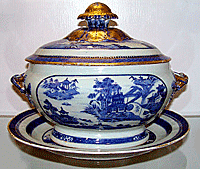
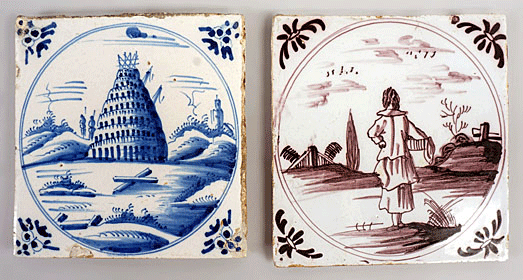
At first, American craftsmen copied the Old World designs—furniture
designs by Thomas Chippendale, Delftware and tiles from Holland.
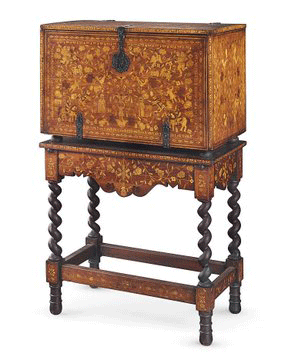 Not
only European styles but the crafts of Native Americans influenced
American antiques. Each era left its mark on furniture, decorative
objects, ceramics, and artifacts. From colonial elegance to the
simplicity of Shaker furniture, to folk art pieces and objects from
pre-Columbian civilizations, American antiques are rich in both variety
and importance. Not
only European styles but the crafts of Native Americans influenced
American antiques. Each era left its mark on furniture, decorative
objects, ceramics, and artifacts. From colonial elegance to the
simplicity of Shaker furniture, to folk art pieces and objects from
pre-Columbian civilizations, American antiques are rich in both variety
and importance.
American antiques have unique characteristics, stemming from diverse
cultural influences, and the practical needs of the communities that
produced them.
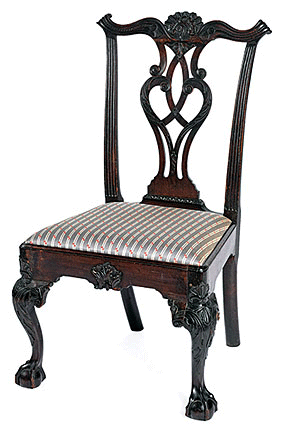 Early
American art and design reflected the influence of European
styles—English, Spanish, French, and Dutch----which mingled with the
techniques and local materials available. Early
American art and design reflected the influence of European
styles—English, Spanish, French, and Dutch----which mingled with the
techniques and local materials available.
Furniture and furnishings were often made from native woods such as
cherry, maple, walnut, and oak. The use of wrought iron and glazed
ceramics is typical of areas colonized by the Spanish.
Unlike European furnishings, which were often more ornamental, American
cabinetmakers designed many furniture pieces to be functional, durable,
and suitable for life in the colonies and frontier lands.
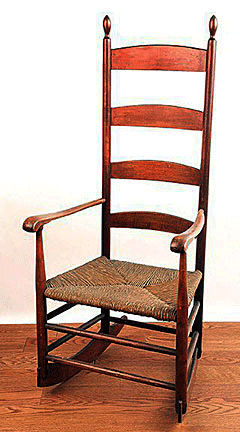 Styles
such as Shaker or Puritan featured minimal decoration, devoid of
ornamentation, with simple lines, precise joints, and high quality
materials. In others, such as Victorian or Spanish Colonial, carvings
and decorative paintings became distinctive elements. Styles
such as Shaker or Puritan featured minimal decoration, devoid of
ornamentation, with simple lines, precise joints, and high quality
materials. In others, such as Victorian or Spanish Colonial, carvings
and decorative paintings became distinctive elements.
The Shakers developed an extremely functional furniture style devoid of
ornaments. Their creations were characterized by simple lines, precise
joints, and high-quality materials.
Solid forms, modest decorations, and unique materials, combined with the
influence of European styles, set American antiques apart. The most
iconic pieces—Windsor chairs, massive tables, and sideboards----stand
out in the antiques world.
<
Back to Antiques Extra! Archives |