Moovelous!
QUESTION:
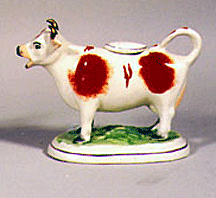 My
great aunt gave me a funny little pitcher shaped like a cow. It has no
markings on it. Can you tell me anything about it? My
great aunt gave me a funny little pitcher shaped like a cow. It has no
markings on it. Can you tell me anything about it?
Thanks
Georgiana
_______________________________________________________
ANSWER:
What Gerogiana has is a cow creamer. Originally made
in England, then in Scotland and America, these unique creamers were
the pride and joy of many late 18th and early 19th-century English
housewives. They kept these spotted bovines sitting on top of their
dining room dressers, ready to use on special occasions.
These pottery cow creamers are usually about six inches long and
four to five inches high. Housewives would pour fresh cream through
a hole in the cow’s back, then seal up the whole with a cover.
Unfortunately, many a cow creamer today is missing its cover. The
cow’s curved tail served as the handle while its mouth served as the
spout.
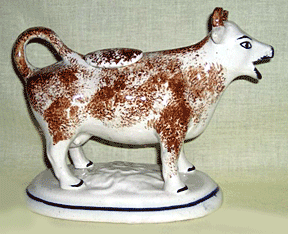 The
first cow creamer came from the Whieldon Pottery, which imitated the
silver cow jugs made in 1755 by John Schuppe. The most well-known of
these had a mottled brown tortoise shell-type glaze. Others had
brown and yellow spots, black with a criscrossed yellow pattern, and
even light blue with yellow circles. The
first cow creamer came from the Whieldon Pottery, which imitated the
silver cow jugs made in 1755 by John Schuppe. The most well-known of
these had a mottled brown tortoise shell-type glaze. Others had
brown and yellow spots, black with a criscrossed yellow pattern, and
even light blue with yellow circles.
It seems every potter added his touch of whimsy. In fact, there are
almost as many different decorations as there are creamers.
Staffordshire potters also crafted these unique little jugs,
essentially copying from the earlier Whieldon design. None of these
have markings on the bottom. The Welsh potters added their own
creative touches to their cow creamers. Many decorated them freehand
or applied transfer designs of rustic farm scenes. After 1850, the
Scots developed a love affair with the cow creamer. Scottish potters
experimented with sponged decoration and brightly colored glazes.
After the American Revolution and into the early 19th century,
imported English pottery became too expensive, so the United States
Pottery in Bennington, Vermont, began making its own version of the
cow creamer. Each cow had crescent-shaped nostrils, open eyes, folds
in the neck, and visible ribs. I guess the American cows weren’t as
well fed as their English, Scottish, and Welsh cousins. After
Bennington closed in 1858, its potters sought work at potteries in
Ohio, Maryland, and New Jersey, taking their skill at making cow
creamers with them.
< Back
to Readers Ask Archives
Next
Article > |