Reproduction Furniture—Is
It All That Bad?
by
Bob Brooke
 Furniture
reproductions have been popular for a great many years, but the number
of antiques being reproduced and sold as such has never been greater
than at the present time. Furniture
reproductions have been popular for a great many years, but the number
of antiques being reproduced and sold as such has never been greater
than at the present time.
Pre-eminent
examples are the reproductions of 18th-century furniture made under the
auspices of
Colonial Williamsburg in Virginia and
Winterthur in
Wilmington, Delaware. Just as much care has been taken to duplicate the
furnishings of the buildings and homes in Williamsburg as in the pieces
from Winterthur's extensive collection of Americana. An original has
been used as the model for each reproduction. Other restorations, like
the Historic New Orleans Collection or the Historic Natchez Collection
specialize in equally authentic 19th-century antiques of one kind or
another.
Furniture is available
in the widest range. There's furniture of contemporary manufacture
that's referred to as "period" or "traditional"
because its design is based on details characteristic of various 18th--
or 19th-Century styles. Such furniture isn't an actual reproduction.
Authentic replicas are most common in 18th-century styles, and a few
earlier pieces also are available.
One type of
reproduction that's usually excellent is the piece made by a skilled
cabinetmaker, such as those at the Hancock Shaker Village, outside
Pittsfield, Massachusetts. It's often possible to obtain from such a
cabinetmaker a pre-Victorian piece of the early 1800's. However, the
price will be close to what's being asked for an original of the same
period. Generally speaking, the furniture reproductions sponsored by
restorations are about as close as you can get to antiques.
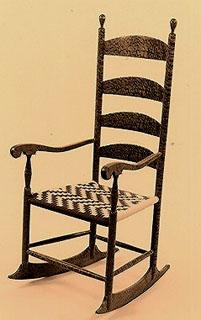
Furniture illustrates
the broad range of reproductions with which many people are content. It
breaks down into two main groups: machine made or handmade. In weighing
reproduction versus an antique, remember that the originals were
handmade until 1830 and in some cases many years thereafter. Accurate as
current "furniture store" reproductions of early Victorian
sofas, chairs, a tables may be, they're still factory-made.
Cabinetmakers turned the original models in their shops. The details of
construction and carving, therefore, appear quite different to knowing
eyes. And any reproduction, however accurate, lacks the patina wood
acquires through years of use and polishing.
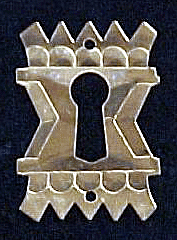 Equally good examples
of the two chief methods of reproduction can be found in furniture
hardware. Strap hinges tipped with a bean, ball and spear, or a heart,
which probably were the first type made in America; and H and HL hinges
can now be purchased in almost any neighborhood hardware store. However,
the examples of these pieces available in retail stores are
machine-stamped. Nevertheless, it's possible to buy old-style, hinges as
well as latches, bolts, and other household hardware at a restoration
such as Old Sturbridge Village in Sturbridge, Massachusetts, where
they're forged or hand-hammered by a working blacksmith. Equally good examples
of the two chief methods of reproduction can be found in furniture
hardware. Strap hinges tipped with a bean, ball and spear, or a heart,
which probably were the first type made in America; and H and HL hinges
can now be purchased in almost any neighborhood hardware store. However,
the examples of these pieces available in retail stores are
machine-stamped. Nevertheless, it's possible to buy old-style, hinges as
well as latches, bolts, and other household hardware at a restoration
such as Old Sturbridge Village in Sturbridge, Massachusetts, where
they're forged or hand-hammered by a working blacksmith.
The difference between
machine-made and handmade hardware may be so subtle as to be
unnoticeable to anyone except an expert, but the handmade replicas are
certainly preferable for a cupboard or other piece that's being
restored.
Unfortunately, while
most original pieces of furniture are better constructed than today's
mass produced models, they can suffer added wear and tear in high
traffic situations such as in offices and busy living rooms. In these
cases, it's better to purchase a fine reproduction piece, for which the
value won't suffer in case of damage through hard use. The older a piece
of furniture is, the more likely it's worth a good deal of money. But
the reproduction piece should be known as such to differentiate it from
the original.
To read
more of my articles, please
visit
my Web site.
<
Back to Antiques Articles
Next Article >
|