|
What's It Worth?
by
Bob Brooke
 With
the popularity of the PBS’s “Antique Roadshow,” everyone seems to be
asking “How much is it worth?” In the world of antiques and
collectibles, the value of an antique or collectible depends on three
things: First, how many of the items are available. Second, what’s its
condition. And, third, how much someone is willing to pay for it. With
the popularity of the PBS’s “Antique Roadshow,” everyone seems to be
asking “How much is it worth?” In the world of antiques and
collectibles, the value of an antique or collectible depends on three
things: First, how many of the items are available. Second, what’s its
condition. And, third, how much someone is willing to pay for it.
The number of antiques from older periods reduces as the years go by,
either because they’ve all been bought up or through damage or breakage.
And television antique evaluation programs like “Antiques Roadshow”
haven’t helped. They’ve stopped families who would have thrown away old
items from doing so with the thought that they might be worth something.
Also, these programs have made the chance of finding a bargain in a shop
a bit more unlikely. And thanks to television, everyone’s wise to
antiques these days. So everyone thinks whatever they have must be worth
something!
The condition of an antique or collectible greatly affects its value. It
stands to reason that a dedicated collector wouldn’t want to buy damaged
goods. The better condition of a piece, the greater its overall value.
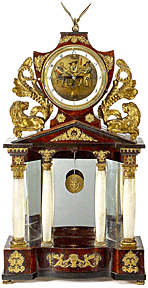
But there are exceptions. For instance, 18th and 19th-century furniture
is believed to have been used. This is especially true of “country”
antiques. Dents, stains, and minor scratches sometimes add to the value.
Antique dealers call this “patina.” An very old piece should never be
refinished. It’s value is in its wear and patina.
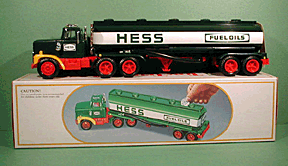 On
the other hand, a collectible like Hess Toy trucks, becomes more
valuable the more “mint” its condition. In the case of Hess trucks—in
fact, most toys—the condition of the box is half the value. To these
collectors, MIB or “mint-in-box” increases the value tremendously. A
1964 Hess truck, that originally sold for $1.39 is now worth $4,000—that
is, if it’s MIB. On
the other hand, a collectible like Hess Toy trucks, becomes more
valuable the more “mint” its condition. In the case of Hess trucks—in
fact, most toys—the condition of the box is half the value. To these
collectors, MIB or “mint-in-box” increases the value tremendously. A
1964 Hess truck, that originally sold for $1.39 is now worth $4,000—that
is, if it’s MIB.
Finally, any antique or collectible is worth only as much as someone is
willing to pay for it. When the supply is low, collectors will pay a
higher amount for an item just so they can own it. When the market is
flush with goods, the value of those items goes down. It’s like any
other goods in retail. However, when a collector is planning to sell an
item, he or she shouldn’t expect to get much more than half of its
value. That’s because dealers need to mark the item up to make a profit.
When an appraiser on Antiques Roadshow says an item is worth $5,000,
that means the seller would get about $2,500 for it.
 To
make sure they’re buying for the best value, you should know as much
about your chosen type of antique as possible. Knowledge is essential to
making good antique purchases. Therefore, a person who owns or finds
antiques must learn something about them before offering them for sale.
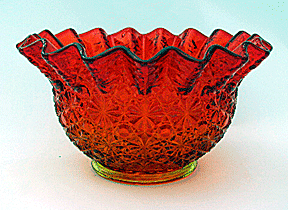
It’s not enough to be halfway convinced that the iridescent,
marigold-hued glass bowl that’s been kept in a cupboard because it came
from someone’s home and hadn’t been used, is carnival glass. When a
collector attempts to make certain that it is, he or she will discover
that there’s a brisk market for this glass, which is hardly old enough
to be antique. Because of the current demand, the bowl which may have
been acquired as a premium can be sold now for several dollars. To
make sure they’re buying for the best value, you should know as much
about your chosen type of antique as possible. Knowledge is essential to
making good antique purchases. Therefore, a person who owns or finds
antiques must learn something about them before offering them for sale.
It’s not enough to be halfway convinced that the iridescent,
marigold-hued glass bowl that’s been kept in a cupboard because it came
from someone’s home and hadn’t been used, is carnival glass. When a
collector attempts to make certain that it is, he or she will discover
that there’s a brisk market for this glass, which is hardly old enough
to be antique. Because of the current demand, the bowl which may have
been acquired as a premium can be sold now for several dollars.
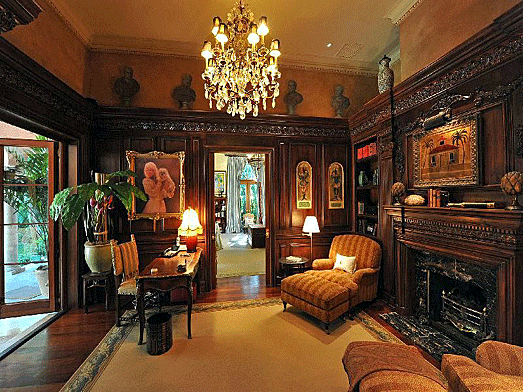 If
selling isn’t urgent, there are several ways you can learn to recognize
and, eventually, evaluate an antique. Visit antique shops and
occasionally attend an auction to learn what’s being offered for sale,
what people are buying, and what prices they’re paying. Your ability to
recognize antiques will be greatly aided by viewing a restored historic
house or village. Every year, more and more of them open to the public,
and almost every state now has at least one. Because restorations show
how people lived, they’re full of everyday things. More than one
restoration visitor has been reminded of a 19th-century duplicate
consigned to a cupboard at home as too ordinary to be considered an
antique but too good to throw away. If
selling isn’t urgent, there are several ways you can learn to recognize
and, eventually, evaluate an antique. Visit antique shops and
occasionally attend an auction to learn what’s being offered for sale,
what people are buying, and what prices they’re paying. Your ability to
recognize antiques will be greatly aided by viewing a restored historic
house or village. Every year, more and more of them open to the public,
and almost every state now has at least one. Because restorations show
how people lived, they’re full of everyday things. More than one
restoration visitor has been reminded of a 19th-century duplicate
consigned to a cupboard at home as too ordinary to be considered an
antique but too good to throw away.
So before you pay someone else to tell you what your pieces are worth,
it would pay you to do some digging on your own. And isn’t that half the
fun of collecting antiques?
To read
more of my articles, please
visit
my Web site.
<
Back to Antiques Articles
Next Article >
|