What Exactly is an Antique?
by
Bob Brooke
 To
anyone who browses antique shops these days the question "What is
an antique?" seems to have many answers. Side by side with
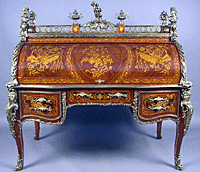
ancient-looking furniture and. old- fashioned china, browsers may find
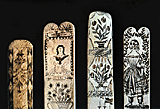
ruffled pink glass and souvenir spoons, no older than themselves. The
problem bewilders not only buyers but dealers, too. To
anyone who browses antique shops these days the question "What is
an antique?" seems to have many answers. Side by side with
ancient-looking furniture and. old- fashioned china, browsers may find
ruffled pink glass and souvenir spoons, no older than themselves. The
problem bewilders not only buyers but dealers, too.
In 1930 the U.S. Government ruled that objects had to
be at least a 100 old to be classified as antiques, so they could be
admitted duty free into the U.S. But that was a legislative tax
decision. Since then antiques have often been defined as objects made
before 1830.
In Europe, items as recent as that seem quite young.
In contrast with a classic Roman head, an 18th-century chair is modern.
Antique shops in European cities are often called “antiquities”
shops. Except for Indian relics and a few Spanish buildings in the
Southwest, the oldest American antiques are but 300 years old.
 Yet Americans experience the same contrast in their
shops. To a New Englander who knows the pine furniture of Pilgrim days,
a Victorian sofa doesn’t seem antique. But in Nebraska or Oregon it
does, because it represents the earliest furnishings in the region. The
age of antiques seems to vary in relation to their environment. And so
the perception of “What is antique?” changes from region to region
and one part of the world to another. Yet Americans experience the same contrast in their
shops. To a New Englander who knows the pine furniture of Pilgrim days,
a Victorian sofa doesn’t seem antique. But in Nebraska or Oregon it
does, because it represents the earliest furnishings in the region. The
age of antiques seems to vary in relation to their environment. And so
the perception of “What is antique?” changes from region to region
and one part of the world to another.
Americans often count among their antiques items made
by machine as well as those wrought by hand. Most of these are later
than 1830. That date does, however, serve as a dividing line between the
age of craftsmanship and the machine age.
 Legends grow on antiques the way moss grows on trees.
As a family heirloom is passed from one generation to the next, its
history takes on added flourishes. A spinning wheel made in 1820 becomes
the spinning wheel brought over on the Mayflower. A bed of 1840 becomes
a bed George Washington slept in. Legends grow on antiques the way moss grows on trees.
As a family heirloom is passed from one generation to the next, its
history takes on added flourishes. A spinning wheel made in 1820 becomes
the spinning wheel brought over on the Mayflower. A bed of 1840 becomes
a bed George Washington slept in.
But while the personal associations of heirlooms add
to their interest, they can’t be relied upon to place their date and
source. Not every old piece has a pedigree or a maker’s mark or label,
but every one has characteristics that identify it which make it
valuable to someone else. The secret of where and when and by whom it
was made is in its material, its design, and its workmanship. So an
antique is what the collector knows or perceives it to be. Nothing more.
To read
more of my articles, please
visit
my Web site.
<
Back to Antiques Articles
Next Article >
|